
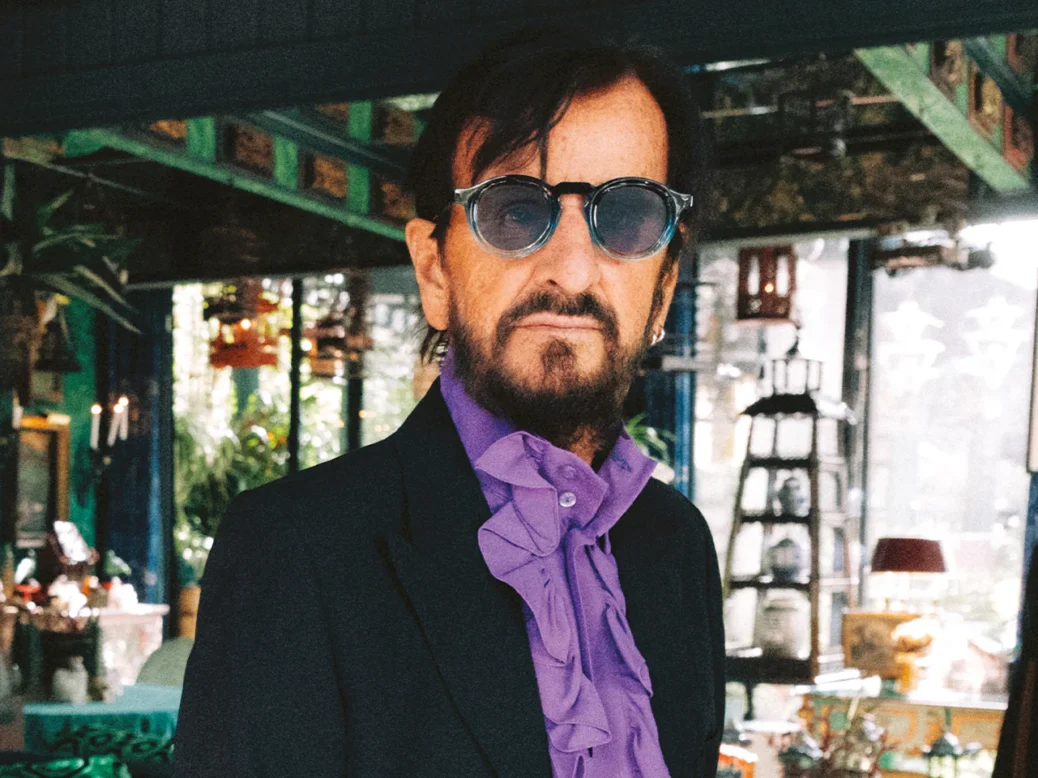
When I listen to a new Paul McCartney song, I find myself searching for signs that the genius is still there. I’m scornful if he uses an obvious chord progression: then I remember he probably invented that particular chord progression sixty years ago. Ringo Starr was never a genius, so as time has gone by, his own solo records have taken on a value proportional to his age, which cannot be said of Paul. Starr’s warm and ploddy voice is, at 85, a piece of living history, and his steady drip-drip of releases – a creative impulse that is never explained, because he doesn’t really give interviews – is a trailing root to the past that we currently take for granted.
In the late Fifties, Ringo was the busiest drummer in Liverpool, largely because he owned his own kit. He was a tough little figure with signet rings playing in skiffle bands, but his heart lay in country music – so much so that he applied to the American Embassy for factory work in Texas, simply so he could be nearer to Lightnin’ Hopkins. The embassy paperwork proved too much of what Ringo might call a ‘drag’, so he never completed it. It was his Sliding Doors moment – though I’m pretty sure the Beatles would have existed without him.
The Long, Long Road is his third country album. There was one last year too, produced and co-written, as this one was, by T-Bone Burnett, the King Midas of country, who worked on everything from O Brother Where Art Thou to HBO’s Nashville. This is classic country in the Fifties mode, with the feel of what they’d call “Western swing” – it brings to mind boot-lace ties, and black-and-white TV studios, loaded with hay bales. Being booth loveable and legendary, Starr is able to attract classy musicians to sing his harmonies: St Vincent appears on “Choose Love”, Sheryl Crowe on the title track, and the wonderful bluegrass singer Sarah Jarosz on “It’s Been Too Long”. The instrumentation is predictably perfect, with fluttery guitar from the appropriately named musician Bill Strings. There is a cover of “I Don’t See You In My Eyes Anymore”, covered by Carl Perkins in 1959 – the same year Ringo nearly moved to Texas.
[Further reading: Lily Allen’s revenge tour]

Content from our partners



Related

Join the debate
Subscribe here to comment